


PMU Room Ideas: Design Your Premium Makeup Studio
PMU Room Ideas: Designing a Permanent Makeup Studio That Commands Premium Prices
Your PMU room is your pricing argument. A client sitting in a dim, cramped space with mismatched furniture will hesitate to pay $500 for eyebrows. A client in a polished, intentional studio with controlled lighting and curated aesthetics expects to pay premium rates—and does. The design of your permanent makeup space isn't secondary to your skill; it's inseparable from it. Your PMU room ideas should reflect that your work is medical-grade precision wrapped in luxury.
This isn't about expense. It's about intentionality. You don't need a $10,000 build to create a studio that feels elevated. You need a clear design direction, strategic furniture selection, and understanding of how lighting, color, and layout communicate professionalism. This guide walks you through four distinct PMU room ideas, the essential furniture and layout principles, and how to build a studio at any budget.
Why PMU Studio Design Affects Your Pricing Power
Your studio design is part of your value proposition. Before your needle touches skin, your client has already formed an impression of your caliber and professionalism based on the space they're sitting in.
Permanent makeup is a semi-permanent procedure—a significant decision and investment for the client. They're trusting you with their face for years. The environment matters. A client in a clean, aesthetically considered PMU room perceives higher quality, more safety, and more permanence in the outcome. They're willing to pay for it. A client in a makeshift space—even if your work is stellar—questions whether they're getting professional-grade precision.
Beyond psychology, your studio design affects your work quality. Proper lighting eliminates shadows and lets you see pigment placement with accuracy. A stable, ergonomic setup lets you work with precision without strain. Strategic layout means you move efficiently between consultation, prep, application, and aftercare—which improves your client experience and your throughput.
Studios don't need to be large. A 150 sq ft salon suite can feel expansive and intentional if the design is cohesive. A poorly designed 300 sq ft space can feel chaotic and cheap. The difference is strategy, not square footage.
The Challenge: Clinical Precision + Luxury Aesthetics
PMU is a semi-medical procedure. Your space needs to communicate both clinical precision and beautiful luxury simultaneously. That's the design challenge.
You're not designing a spa (too soft, not enough "this is serious"). You're not designing a dermatology office (too sterile, not enough warmth). You're designing a space that says: "I know what I'm doing. I have the equipment and environment to prove it. And you're going to feel like you're being cared for while I do it."
This balance shows up in color choice, material selection, lighting approach, and furniture curation. A PMU room that leans too heavily into luxury loses credibility—it reads as cosmetic, not clinical. One that leans too heavily into clinical feels cold and unsafe. Your design direction should acknowledge both elements.
Four Design Directions for PMU Studios
1. Clinical Luxe
Color palette: Warm whites, soft beige, champagne gold or warm brass accents.
Vibe: Clean, upscale medical-adjacent, elevated minimalism.
Best for: Artists targeting high-ticket clientele; brow, lip, and eyeliner specialization.
Clinical Luxe is the most versatile PMU room direction. It reads as professional without feeling cold, and it complements any client demographic.
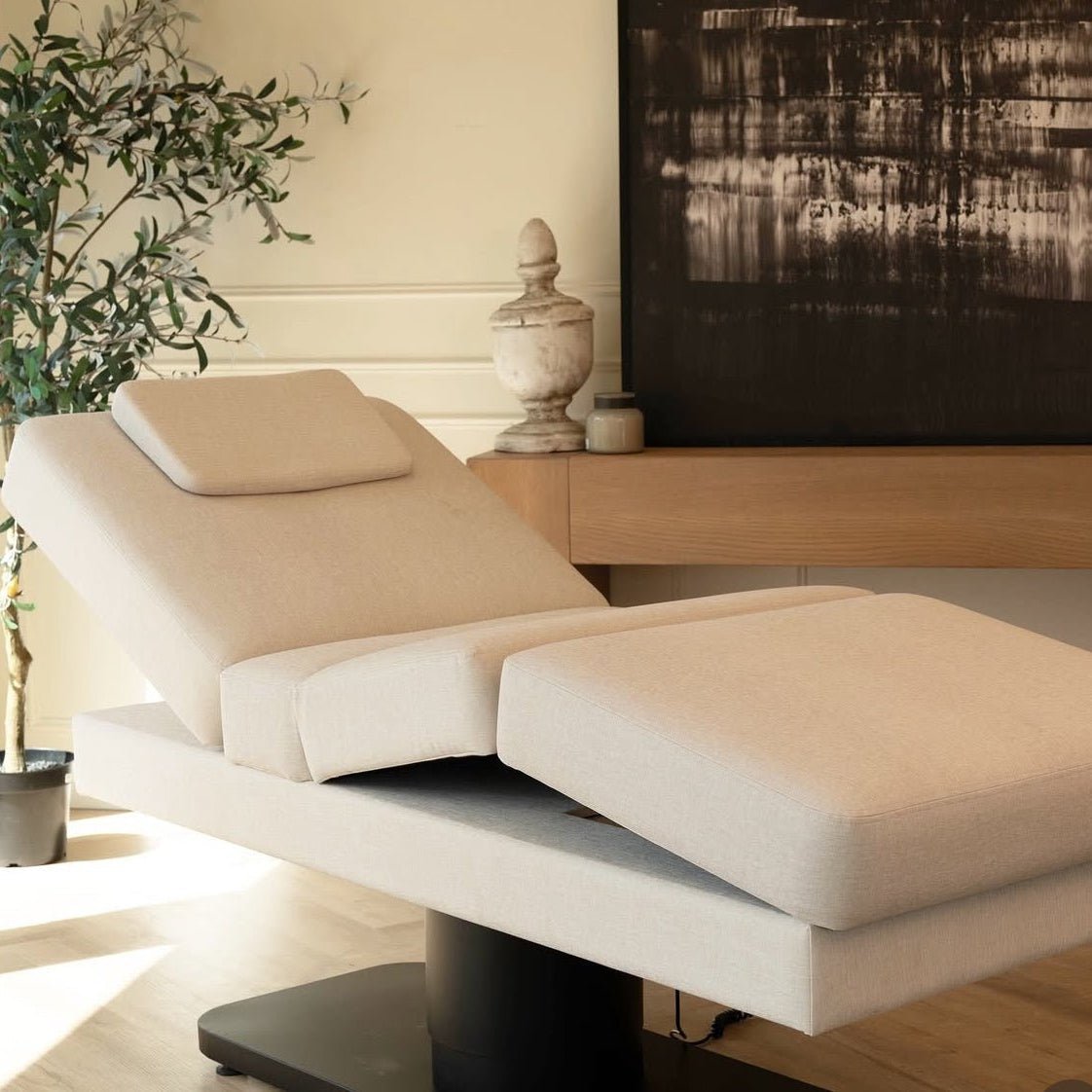
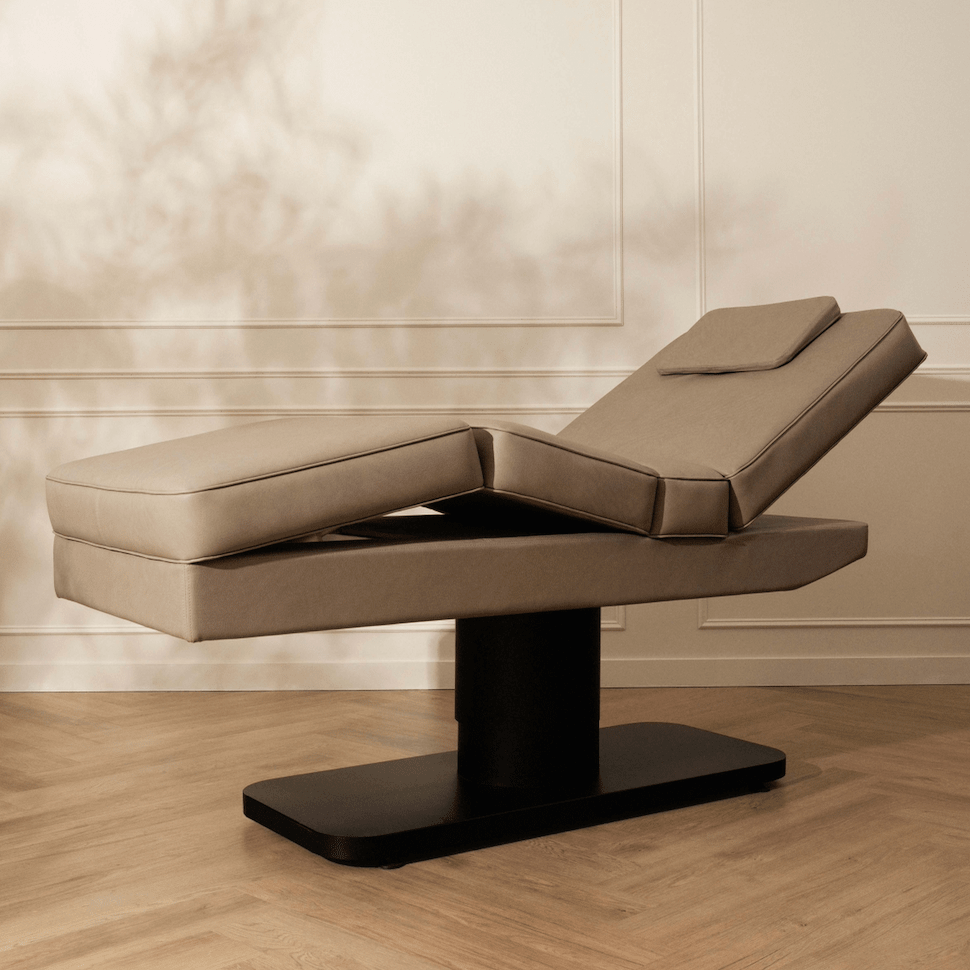
Your PMU room walls are soft white (not stark white—look for warm whites like ivory or off-white with beige undertones). Your bed is upholstered in cream, warm beige, or soft taupe. Accent fixtures—task lighting, mirror frame, stool base—are warm brass, champagne gold, or matte brass. Add one accent: a soft area rug in cream or light grey, or a single piece of art (abstract, minimal).
Storage is sleek and hidden—white rolling carts, closed shelving, or built-in cabinetry. Mirrors are framed in brass or warm metal. Your lighting is clinical-grade (full-spectrum, shadow-free) but the fixtures themselves are design-forward—not industrial-looking.
Furniture picks for Clinical Luxe: Cream or taupe upholstered PMU bed, brass or gold task lighting, clear or frosted glass shelving, a minimalist artist stool in white or soft grey, a simple wooden or metal console for consultation seating.
Psychology: Clinical Luxe signals expertise and control. Clients feel safe. The warm metals prevent the space from feeling sterile. This direction works equally well for experienced artists commanding $600+ services and for those building reputation.
2. Dark Moody Studio
Color palette: Charcoal or deep grey walls, matte black accents, cream or camel upholstery.
Vibe: Dramatic, editorial, high-ticket, intimate.
Best for: Artists with a strong personal brand; fashion-forward clientele; premium pricing.
Dark Moody is bold. It signals confidence and exclusivity. Your PMU room feels like a private atelier, not a generic treatment space.
Walls are a deep, soft charcoal or warm grey (not black—too much). Your PMU bed is upholstered in cream, camel, or soft grey—a color that reads as luxury against the darker walls. Accents are matte black: task lighting fixtures, mirror frames, stool base, shelving brackets. Add warmth with brass or gold details—a single brass floor lamp, brass shelving, or gold-trimmed mirror.
Lighting must be excellent in a dark room. Invest in shadow-free task lighting and a high-quality ring light. The dark walls absorb light, so you need more of it to work precisely. This direction demands higher lighting budget.
Furniture picks for Dark Moody: Camel or cream PMU bed, matte black ring light or surgical light, black metal artist stool, cream or grey rolling cart, brass floor lamp, statement mirror with dark or brass frame.
Psychology: Dark Moody communicates editorial sophistication and exclusivity. Clients feel like they're in a luxury experience. This direction attracts clients willing to pay premium rates and those who value aesthetic as much as results.
3. Warm Minimalist
Color palette: Warm whites, natural wood tones, soft sage green or muted blue accents.
Vibe: Approachable premium, clean, nature-inspired, calm.
Best for: Artists targeting wellness-minded clientele; estheticians offering multiple services; mid-to-premium pricing.
Warm Minimalist is inviting without being generic. It's the easiest direction to execute affordably, and it appeals to clients who want professional precision with a touch of calm.
Walls are warm white or cream. Your PMU bed is upholstered in cream, soft grey, or warm taupe. Accent pieces are natural wood (light oak, warm walnut, or similar) or soft-toned metals. Add one accent color sparingly—a muted sage green (on a single shelving unit or in art) or soft dusty blue (in a throw pillow or accent wall). Greenery—a single potted plant or a low-maintenance faux plant—adds life without clutter.
Storage is natural wood or white, with open shelving that displays products beautifully but intentionally. Lighting is warm and full-spectrum (not clinical-bright). A simple wood-framed mirror and natural materials throughout create cohesion.
Furniture picks for Warm Minimalist: Cream or taupe PMU bed with wood frame or legs, natural wood shelving or cart, wood-framed mirror, simple artist stool in natural wood or soft upholstery, warm-toned task lighting.
Psychology: Warm Minimalist signals competence and care. Clients feel calm and supported. This direction works well for PMU artists who also offer other services (lash lifts, facials, waxing) and want a studio that feels welcoming across services.
4. Maximalist Beauty
Color palette: Jewel tones (emerald, sapphire, blush), velvet accents, gold or brass fixtures.
Vibe: Bold, personality-driven, luxe, artistic.
Best for: Artists with a strong personal brand; beauty-obsessed clientele; established studios with confident positioning.
Maximalist is unapologetic. Your PMU room is a statement. It works beautifully if you execute it with intention, but it requires more budget and stronger design curation.
Walls might be a jewel tone (deep emerald or sapphire) or warm white with jewel-toned accents. Your PMU bed is upholstered in a bold jewel tone or in luxury velvet (blush, emerald, or jewel blue). Accents are gold or brass. You include one art piece or mirror that makes a statement—a large brass-framed mirror, an art deco-inspired fixture, or a curated gallery wall.
Storage and shelving are intentional: think gold-rimmed glass shelves, a velvet-upholstered stool, or a jewel-toned rolling cart. Lighting is warm and focused, highlighting both work areas and accent pieces.
This direction demands good taste and restraint. Too much color or pattern reads as chaotic, not luxury. Stick to one or two jewel tones, balanced with neutrals and gold. Less is more in Maximalist.
Furniture picks for Maximalist: Jewel-tone or velvet PMU bed, gold-framed mirror, gold task lighting, velvet-upholstered artist stool, gold and glass shelving, a single statement art piece or plant.
Psychology: Maximalist signals creativity, confidence, and artistry. Clients feel like they're in a luxe, unique space. This direction attracts clients who value the artist's personal brand as much as the technical work.
Essential PMU Studio Furniture
Beyond the PMU bed, your studio needs these pieces:
Artist stool. Your primary seating. Look for adjustable height (18–24 inches, typically), a backless or low-back design (backless preferred; a high back limits your movement and posture), and 360-degree swivel. Your stool should be comfortable for 2–3 hours but supportive—not cushy. Budget $150–400. Popular options include saddle stools (which encourage forward posture) and gas cylinder stools with footrings.
Rolling trolley or cart. For storing pigments, needles, tools, and supplies within arm's reach during work. Look for stainless steel or powder-coated steel (easy to sanitize), smooth-rolling wheels, and at least two tiers. Budget $100–300.
Ring light or task lighting. Critical. See the FAQ section on lighting for specifics. Budget $200–800 depending on quality and features.
Large mirror. Your client needs to see their results post-procedure, and you need one for client consultations and shade matching. Look for a wall-mounted or standing mirror, 24–36 inches wide, with good lighting around it (integrated LED is common). Budget $150–500.
Consultation chair. A comfortable, professional-looking chair or small sofa where clients sit during consultation and patch test. Doesn't need to be matched to your PMU room design, but should be cohesive. Budget $200–600.
Storage. Closed cabinetry, shelving, or a dresser for pigments, supplies, and client files. This keeps your workspace visually calm and organized. Budget $200–1,000+ depending on material and size.
Shelving or display. If you're using open shelving (which looks more expensive and curated than closed storage), invest in organizing products beautifully. This is part of your visual storytelling. Budget $100–400 for shelving; budget time for thoughtful product display.
Lighting for PMU: The Critical Element
Lighting is non-negotiable. You cannot do precision pigment work in poor light, and clients cannot assess results in dim lighting.
Full-spectrum task lighting is your foundation. This means bulbs rated 5000K–6500K (daylight equivalent), which replicates natural light and prevents color distortion. Your eyes need to see true colors to match pigment shades accurately. Cheap or warm-toned lighting (2700K–3000K) will make you color-match incorrectly, leading to shades that look different in natural light.
A ring light (typically 14–18 inches diameter) positioned above the treatment area is the gold standard for PMU. It eliminates shadows, provides even illumination across the client's face, and allows you to see pigment placement with precision. Most ring lights include adjustable color temperature and brightness. Invest in a quality ring light ($300–800); cheap ones flicker and cast shadows.
Overhead ambient lighting should be bright but not harsh. Some studios use recessed LED panels; others use track lighting. The goal is to light the entire room evenly so you're not creating shadows anywhere. Avoid pendant lights over the treatment area—they cast shadows directly where you're working.
Window considerations. Natural light is beautiful but inconsistent. If your PMU room has windows, use sheer curtains or frosted film to diffuse sunlight. Don't rely on natural light alone; you need consistent, controlled lighting for color accuracy.
Lighting budget. A quality ring light ($400–600) plus overhead LED panels or track lighting ($300–500) plus task lamp ($100–200) puts you in the $800–1,300 range. This is non-negotiable investment.
Layout Strategy for a Small PMU Suite
Most PMU artists work in 100–250 sq ft spaces—often a single salon suite or a corner of a larger studio. Small doesn't mean cramped; intentional layout creates flow.
The work zone (40–50 sq ft) is your PMU bed, artist stool, ring light, trolley, and immediate workspace. Position your bed with the head facing a wall (so your clients aren't looking at the door or window during procedure). Your stool should be directly beside the bed, close enough that you don't reach or lean. Your trolley should be within arm's reach. Keep this zone clear—no unnecessary furniture.
The consultation/waiting area (30–50 sq ft) is separate but visible from the work zone. This is where clients sit during consultation, patch test, and aftercare review. Include your consultation chair, shade samples displayed on a wall or shelf, and maybe a small table for water or tea. A mirror here (separate from your work mirror) lets clients see themselves during consultation.
The sanitization/prep station (20–30 sq ft) is your sink, autoclave, and supplies. Many salon suites include a small sink; if not, budget for a hand-wash station or portable sink. This should be distinct from the treatment area—clients shouldn't see you prepping needles right beside where they're lying.
Storage (20–40 sq ft) can be on walls (floating shelves, wall-mounted cabinets) or tucked into corners. Use vertical space; small rooms need to utilize walls rather than floor space.
Traffic flow. Your layout should allow clients to enter the consultation area without walking past the treatment bed. They move from entry → consultation area → treatment area for prep → back to chair for procedure. Then they move to a mirror (consultation area or separate) to see results. This flow prevents awkward moments and makes the experience feel intentional.
Budget Breakdown: Building Your PMU Room at Three Levels
Starter Budget: $2,000–4,000
This budget gets you functional and professional, but with fewer design choices and possibly some DIY or second-hand pieces.
- PMU bed: $500–800 (entry-level, likely manual height adjustment)
- Ring light: $150–300 (functional but basic)
- Artist stool: $100–150
- Rolling trolley: $80–150
- Mirror: $100–200
- Consultation chair: $200–400 (IKEA or budget option)
- Storage/shelving: $200–400 (wall-mounted, basic)
- Paint/decor: $200–400
- Flooring (if new): $0–500 (depends on current state)
- Lighting (overhead): $200–400
Reality: You're choosing one design direction and keeping it simple. Furniture is functional but not premium. You might buy a used PMU bed or a budget option and upgrade later. Paint and intentional styling do a lot of heavy lifting here.
Established Budget: $4,000–8,000
This is where most PMU artists invest once they're profitable and committed to the space long-term.
- PMU bed: $1,000–1,500 (mid-range, electric adjustment)
- Ring light: $400–600 (quality, good color accuracy)
- Artist stool: $200–350 (ergonomic, comfortable for long sessions)
- Rolling trolley: $150–300
- Mirror: $300–500 (framed, design-forward)
- Consultation chair: $400–800 (upholstered, cohesive to design)
- Storage/shelving: $500–1,000 (intentional, possibly custom)
- Paint/decor/art: $300–600
- Lighting (overhead): $400–800 (LED panels or quality track lighting)
- Flooring: $0–1,000 (could include new flooring)
Reality: You're executing one of the four design directions fully. Furniture is cohesive and premium. Your PMU room feels intentional and elevated. This is the investment point where clients notice the difference and justify premium pricing.
Luxury Budget: $8,000–15,000+
Premium everything. Your PMU room is Instagram-worthy and feels like a high-end atelier.
- PMU bed: $1,500–3,000 (premium, all electric, luxury upholstery)
- Ring light: $600–1,000 (professional-grade, possibly with adjustable color temperature)
- Artist stool: $400–700 (designer, highly ergonomic)
- Rolling trolley: $300–600 (stainless steel, design-forward)
- Mirror: $500–1,500 (custom framed, possibly oversized or multiple mirrors)
- Consultation seating: $800–2,000 (upholstered, possibly custom)
- Storage/shelving: $1,000–3,000 (custom cabinetry, possibly with integrated lighting)
- Paint/decor/art: $500–1,500 (professional design, curated art)
- Lighting (overhead): $800–1,500 (integrated LED, possibly dimmer control)
- Flooring: $500–2,000 (new flooring, possibly heated or specialty)
Reality: Every element is premium and cohesive. Your PMU room communicates exclusivity. Clients feel the investment in their experience. You're positioned at the highest price point in your market.
Frequently Asked Questions
What color walls work best for a PMU studio?
Warm whites, soft beige, warm grey, or a single jewel tone (if Maximalist). Avoid stark white (too clinical) and dark colors on large walls (light-absorbing, makes the space feel smaller). Accent walls in a single color can work, but ensure the accent color supports your design direction and doesn't compete with your client's face during consultation and after photos.
How should I light a PMU room?
Layer three types: (1) Full-spectrum overhead ambient lighting (5000K–6500K) to light the entire room, (2) a ring light or surgical light positioned above the treatment area for task lighting with zero shadows, and (3) optional task lamps for specific areas. Your ring light is non-negotiable. Budget $800–1,500 for a cohesive lighting strategy.
What's the minimum size for a PMU studio?
You can work in 100 sq ft, but it feels tight. 150–200 sq ft is comfortable. Anything less than 100 sq ft and you're sacrificing separation between consultation and treatment areas. More important than total size is how intentionally you use the space.
Do I need a separate consultation area?
Ideally, yes. Clients should have a space to sit, view shade samples, and discuss concerns separate from the treatment bed. If your space is very small, a consultation chair positioned away from the bed (even just across the room) creates psychological separation. This makes the experience feel more professional.
Can I use my PMU room for other services?
Yes, if your furniture is adaptable. A versatile PMU bed works for lash lifts and facials. Your design direction should feel cohesive across services. Avoid designing for PMU-only if you might offer other services later; it limits your flexibility.
How much should I spend on decor and art?
Decor and intentional styling (wall color, mirrors, one or two art pieces or plants, thoughtful shelving display) often have more visual impact than expensive furniture. Budget 15–25% of your total room budget on paint, decor, mirrors, and styling. A $5,000 room with a $750–1,000 decor investment will look significantly more expensive than one without.
What about flooring?
Flooring matters for both aesthetics and function. Vinyl plank, polished concrete, or quality laminate are easy to sanitize and durable. Carpet is harder to maintain in a medical setting. If your salon suite has carpet, consider a large washable rug under the treatment area or budget for flooring replacement ($500–1,500 for a small space).
How do I arrange furniture in a really small space?
Vertical storage (wall-mounted shelving, tall narrow carts) saves floor space. Position your PMU bed with the head toward a wall so it doesn't dominate the room. Keep your rolling trolley tucked beside the bed, not in the center. Use corner space for tall shelving or a plant. The goal is to make the space feel open, not cramped.
Ready to build your PMU studio? Browse our PMU Beds — designed for the permanent makeup artist who wants a studio as polished as their work.

Written by Courtney Buhler