



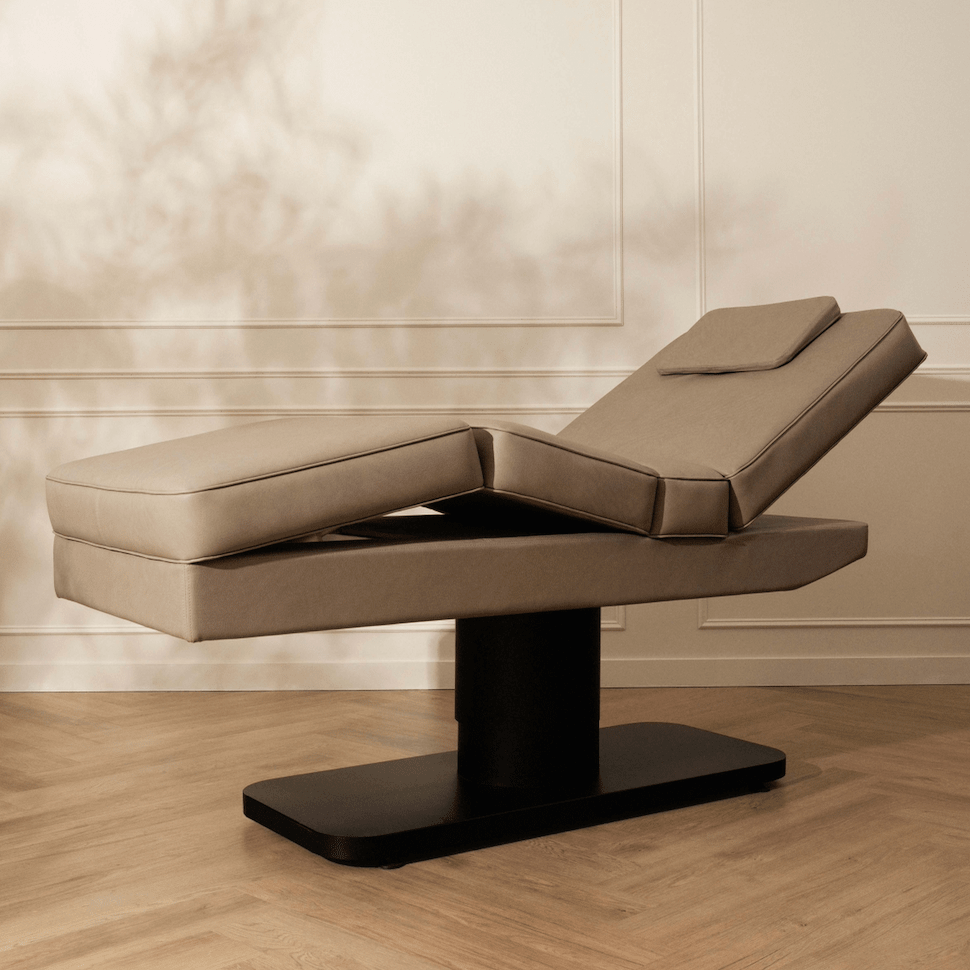
What Is a PMU Bed? Why the Right One Makes Your Work Easier — and Your Business Stronger
What Is a PMU Bed? Why the Right One Makes Your Work Easier — and Your Business Stronger
A PMU bed isn't a massage table. It's also not a facial table.
That seems obvious, but thousands of artists aren't acting like it is. They're buying massage therapy equipment, adding toppers and pillows, and wondering why their clients are uncomfortable after a 3-hour appointment.
A PMU bed is specifically engineered furniture designed to support a client lying still for an extended period while an artist works on detailed facial features with millimeter precision.
It's a completely different product solving a completely different problem.
Here's what separates a real PMU bed from everything else, what to look for when you're shopping, and which features actually matter for your work.
Why PMU Appointments Demand Different Equipment
Permanent makeup sessions run 2-3 hours. That's not a quick beauty service. That's the equivalent of a short massage appointment, but the client is lying on their back instead of their stomach, and they need to be as still as possible.
Why stillness matters: If a client moves even slightly during eyebrow PMU, it changes the angle of the blade. That's how strokes get misaligned. That's how color deposits unevenly. That's how a $500 service turns into a revision appointment that costs you money.
Client stillness is fundamentally your job. And client stillness starts with comfort.
A comfortable client stays still. An uncomfortable client shifts. That shift costs you.
A massage table, or any standard flat bed, is plywood with foam glued on top. The foam is maybe 2-3 inches thick. When your client lies down, her full body weight compresses that foam against the hard base underneath. After an hour, she's feeling pressure points. After two hours, her neck aches. After three hours, she's ready to move off the bed because lying there has become uncomfortable.
That's not a problem for a 15-minute service. For a 3-hour service, it's a fundamental issue.
A PMU bed solves this problem through design: deeper cushioning, support structure that doesn't flatten under pressure, and specific positioning that keeps the client cradled instead of resting on a hard base.
The Features That Actually Matter In A Pmu Bed
DEPTH OF CUSHIONING: 4 INCHES OR MORE
Look for beds with 4 inches of premium foam or more. This matters because it prevents the "bottoming out" effect where the client's body weight compresses through the foam to the hard structure underneath.
With proper depth, the foam stays responsive. It feels soft and supportive throughout the appointment, not firm and tired by the end.
Cheap import beds often have 2 inches of foam. It's enough to feel soft for about 20 minutes. Then it compresses, and the client is effectively lying on plywood.
Suspension System: Tensile Webbing, Not Plywood
This is the invisible difference that explains everything.
Most spa beds have foam glued directly to a plywood base. It's inexpensive to manufacture and easy to ship. It's also terrible for longevity and comfort.
A quality PMU bed has foam suspended on a tensile webbed system underneath. This is the same engineering used in luxury sofas, not budget salon furniture. The foam floats on the webbing instead of resting against a hard surface.
When a client lies down, she's being suspended, not compressed. The bed flexes and breathes. It responds to her weight. Over time, the foam doesn't break down because it's not being crushed against a hard base on every appointment.
This is also why the bed lasts for years. You're not replacing it every two years because the foam has flattened. The suspension system keeps the foam doing its job.
Anti-Gravity Curve: Head And Neck Support

The best PMU beds have an anti-gravity ergonomic curve built into the structure. This isn't a pillow. It's a curve in the bed itself.
When a client lies down, this curve cradles her head and neck naturally and holds her at an angle that's perfect for detail work at the face. It does positioning work automatically. She doesn't need adjustment. Pillows aren't required.
For PMU specifically, this is crucial. You need the client's face positioned at the angle that lets you work with precision. An anti-gravity curve handles this without you having to adjust her or fiddle with accessories.
Some beds offer flat surfaces instead. Those work for other services but aren't ideal for PMU where facial positioning is critical.
Open Leg Clearance For The Artist

The bed legs should be positioned so you have clear space to sit and work comfortably at the head without your knees hitting metal.
Massage tables often have legs in places that force you to squeeze into awkward positions or sit in ways that strain your back.
A PMU bed is designed with the artist's ergonomics in mind. You should be able to sit at the head, pull your stool close, get the angle you need, and not have your legs cramped or your back twisted.
This matters for your longevity as an artist. A bed that forces you into poor posture every appointment adds up to back problems over time.
Client Comfort Features
The best PMU beds have features that make a 3-hour appointment feel like a spa experience, not an endurance test.
Quality upholstery that feels soft to the touch, not plastic or cheap fabric. A headrest that actually supports the head, not compresses it. Materials that are easy to clean and maintain without a mountain of laundry.
Some beds offer optional accessories like bolster pillows or conversion pads that let you adapt the bed for different clients or services. These are nice to have but not essential if the base bed is well-designed.
Construction That Lasts
Look for beds built with quality materials that aren't going to break down in two years.
Premium foam that maintains its properties over time. Stitching that's durable. Upholstery that resists staining and wears beautifully. Structural support that doesn't wobble or creak.
A well-made bed costs more upfront but costs less per year because it lasts 5+ years instead of 2-3.
Aesthetics That Support Your Pricing
This is the part that doesn't get talked about enough: a PMU bed is furniture your client is paying to experience.
It should look premium. It should be in a color that matches your brand. It should feel like you made a deliberate choice about the experience you're creating, not like you picked the cheapest option available.
A beautiful bed communicates that you take your work seriously. A bed in a custom color that matches your brand says "I invested in this experience." A bed that looks like an afterthought says something else.
What Most Artists Currently Settle For
Here's what a typical artist setup looks like:
A massage therapy bed or an inexpensive import salon bed. Usually 2-3 inches of foam on plywood. Usually comes in black or white. Usually doesn't have an anti-gravity curve, so it requires pillows to position the client correctly.
On top of that: a foam topper, colored sheets, maybe a pillow for under the head, maybe a bolster under the knees. It's a MacGyvered setup that works okay for a 20-minute service but gets uncomfortable for anything longer.
The result: clients who are uncomfortable by the end of their appointment. Artists who are making positioning adjustments throughout the session. Rooms that look cluttered because there are pillows and toppers everywhere. Laundry to manage after every client.
It's the default because it's cheap. Not because it's right.
The Plush + Oak Difference
A real PMU bed solves all of these problems at once.
The Edda Cloud and Brynn are the benchmarks in the industry for PMU artists. Both have 4+ inches of premium foam, tensile webbed suspension underneath (so the foam doesn't compress), and deep anti-gravity curves that position the client's head and face perfectly for detail work.
Both come in custom colors so your bed matches your brand instead of defaulting to black or white. Both are built to last 5+ years minimum because the construction is engineered for longevity, not just cost.
The result: clients who are genuinely comfortable during their 3-hour appointment. Clients who stay still because they're comfortable, not because they're enduring it. No toppers. No pillows. No laundry. A bed that looks intentional and premium, which supports your pricing.
And the data backs it up: 98% of PMU artists reported that their clients were more comfortable. 93% saw revenue increase. 94% saw improved client retention.
How To Choose The Right One
If you're doing PMU exclusively: The Edda Cloud or Brynn. Both feature the anti-gravity curve you need for facial positioning. The Edda Cloud is deeper in the curve and is the bestseller for pure PMU artists.
If you're doing PMU plus facials and other services: The Vera 360 or Vera LOFT. These offer hydraulic height adjustment and more positioning flexibility while still featuring anti-gravity support.
If you want full electric control for maximum flexibility: The Oxford. It's the most advanced option, though PMU artists usually don't need its full range since PMU only requires one flat position.
Choose the model that matches your service mix and your ergonomic needs. Choose the color that matches your brand. That's it. You're done.
The Investment Makes Sense
A quality PMU bed runs $3,000-$5,000 depending on the model.
At premium pricing, that bed pays for itself in 10-15 appointments.
But more importantly: the bed isn't just an expense. It's how you enable your pricing. Without it, you're limited by the fact that your setup looks like every other affordable setup. With it, you're one of the serious artists worth premium money.
A real PMU bed isn't a luxury. For artists serious about this business, it's a necessity.
It's time to upgrade to Plush + Oak. See the options. Understand what a real PMU bed is. Then understand why you've been settling for less.
Ready to build your PMU studio? Browse our PMU Beds — designed for the permanent makeup artist who wants a studio as polished as their work.

Written by Courtney Buhler


